Cocktail Attire for Men: What to wear and How Formal to Dress?
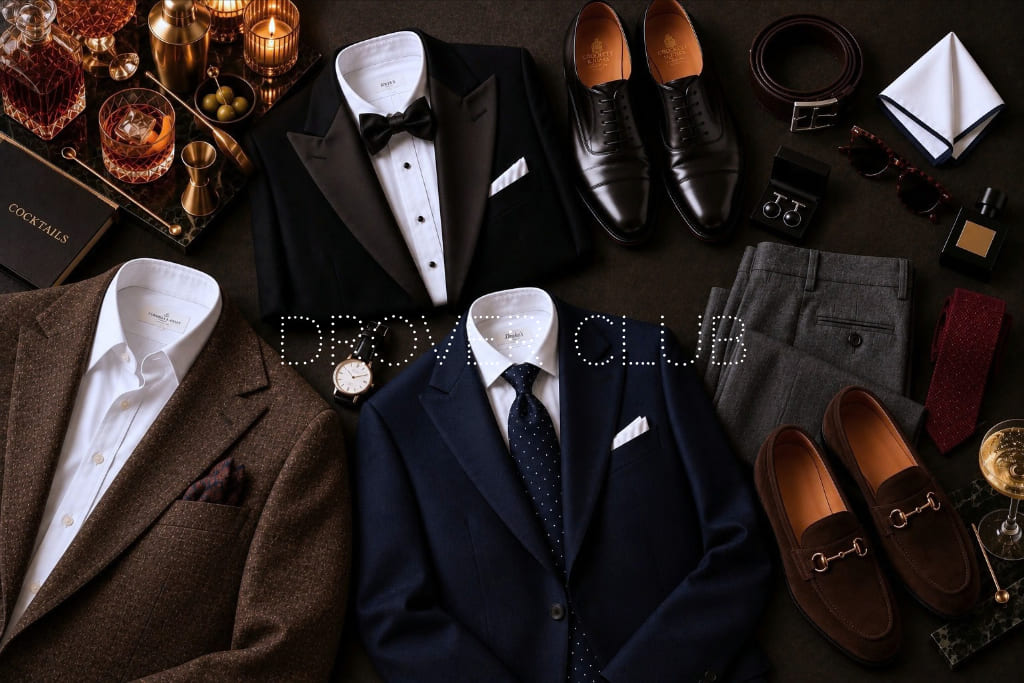
Cocktail attire is a dress code that allows more freedom than Black Tie while still requiring a noticeably more polished outfit than Smart Casual. For men, a well-cut suit with a refined shirt and leather shoes is generally the safest starting point, but it is not the only way to meet the dress code.
The difficulty comes precisely from that flexibility. A wedding reception, rooftop party and dinner can all call for Cocktail Attire without requiring exactly the same level of formality. Depending on the venue, time of day, season and type of event, a suit and tie may be perfectly appropriate in one setting, while a tailored jacket, smart trousers and loafers may work better in another.
The aim is therefore not to find one universal Cocktail outfit, but to understand where your event sits within the Cocktail range of formality. This guide will help you decide when to choose a suit or separates, whether you need a tie, which shoes to wear and how to build an outfit that feels appropriate to the occasion without looking either too casual or excessively formal.
This guide is for you if…
01 - “I have a Cocktail event coming up and I’m not sure how formal I’m supposed to dress.”
02 - “I’m not sure whether I need a full suit or if a jacket and tailored trousers are enough.”
03 - “I don’t know whether I should wear a tie.”
04 - “I want to look dressed for the occasion without looking like I’ve just come from the office or like I’m heading to a Black Tie event.”
Cocktail attire at a glance
There is no single compulsory formula for Cocktail Attire. Instead, think of this as a reliable starting point that can then be adjusted to the event.
This is a starting point, not a uniform. The event then determines whether you should move slightly more formal or more relaxed.
Table of Contents
- What Does Cocktail Attire Actually Mean?
- How Formal Should Cocktail Attire Be?
- How to Decide What to Wear to a Cocktail Event
- The Cocktail Outfit, Piece by Piece
- Suit or Separates? Tie or No Tie?
- How to Make Cocktail Attire Look Like Occasionwear, Not Officewear
- Cocktail Attire vs Other Dress Codes
- Cocktail Wedding Attire for Men
- Cocktail Attire for Different Events
- What Not to Wear for Cocktail Attire
- FAQ - Cocktail Attire for Men
What does cocktail attire actually mean?
Cocktail Attire is a polished dress code for social or celebratory occasions without the precise conventions of Black Tie. It therefore asks for more than smart everyday dressing while still allowing a significant degree of interpretation. For men, a suit is generally the safest foundation. A navy, charcoal or another suitably refined suit, worn with a shirt and smart shoes, works across many Cocktail settings. Whether to add a tie then depends on the level of formality required.
A suit is not the only option, however. In less traditional settings, a well-cut jacket with tailored trousers can also work, provided the complete outfit looks deliberately put together and sufficiently polished for the occasion. This is one of the key differences between Cocktail Attire and more rigid dress codes: Cocktail Attire describes a level of formality rather than one compulsory outfit.
An outfit that sits too close to Smart Casual may lack the necessary polish. At the other extreme, a dinner suit or tuxedo generally belongs to the Black Tie category and can be overly formal when the invitation simply says Cocktail. The aim is to find the right position between those two extremes.
How formal should cocktail attire be?
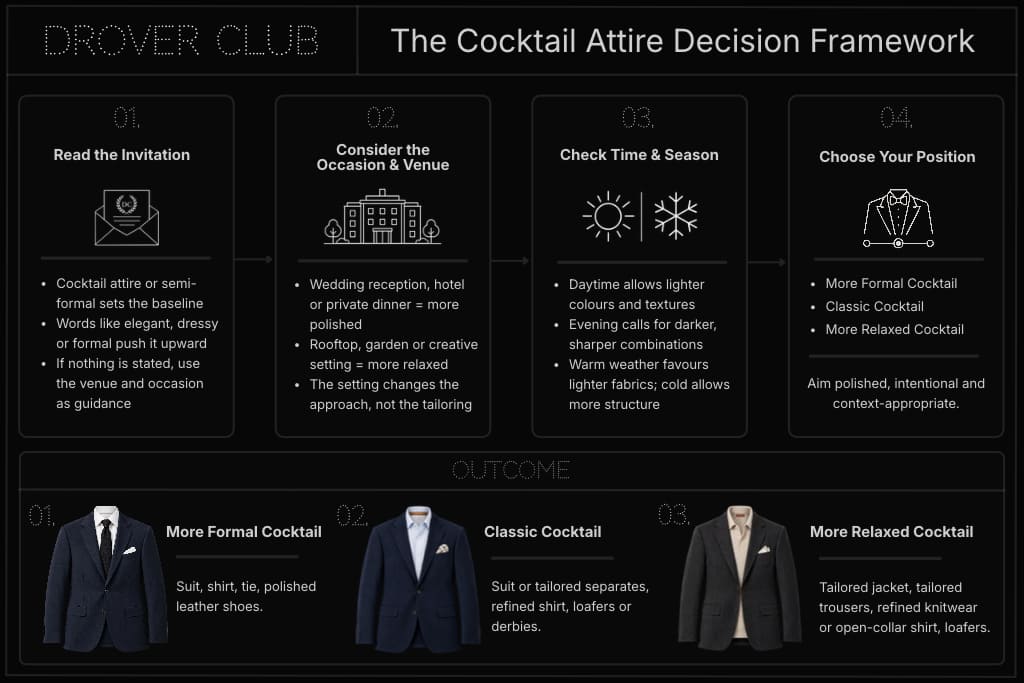
Cocktail Attire does not sit at one fixed point. It is more useful to think of it as a range of formality.
BLACK TIE
↑
MORE FORMAL COCKTAIL → Suit + dress shirt + tie + formal shoes.
|
CLASSIC COCKTAIL → Suit + refined shirt + tie depending on context + smart shoes.
|
MORE RELAXED COCKTAIL → Tailored jacket or softer tailoring + tailored trousers + refined shirt or knitwear + loafers.
↓
SMART CASUAL
The real question therefore becomes: “Where does my event sit within this range?”
A Cocktail wedding held in a formal hotel may naturally push the outfit towards the upper end of the spectrum. A reception on a contemporary rooftop may allow more flexibility. The dress code establishes the general range. The context then helps you find the right position within it. Cocktail attire is not one fixed outfit. It is a range of formality, and the context tells you where within that range you should dress.
How to decide what to wear to a cocktail event?
Two events using exactly the same dress code can still call for different choices. Before selecting the clothes, work out where the event sits on the Cocktail spectrum.
Start with the invitation
The invitation is your first source of information. If it simply says Cocktail Attire, you have a degree of flexibility. Some hosts, however, add further guidance such as summer cocktail, garden cocktail or evening cocktail, which helps clarify their expectations. The venue, time and nature of the event can also provide useful clues. When the guidance remains genuinely ambiguous, asking the host or organiser is better than relying on guesswork. The dress code sets the range. The host’s guidance helps define it more precisely.
Consider the type of event
A wedding reception, dinner, corporate event or film premiere can all use Cocktail Attire without requiring exactly the same outfit. A wedding or traditional occasion generally pushes towards a more formal interpretation. An event in a contemporary or creative environment may leave more room for separates, texture or a tieless look. The useful question is: Should I dress towards the top, middle or lower end of the Cocktail range?
Look at the venue
The venue is often one of the strongest indicators of the expected level of formality.
These are directions rather than absolute rules. The venue helps refine the outfit; it does not replace the dress code.
Consider the time of day
Time can also influence certain choices. A daytime reception more naturally accommodates slightly lighter colours, less weighty fabrics or softer construction. In the evening, deeper shades and sharper tailoring may feel more natural. This should not become an automatic rule, however. A daytime Cocktail wedding may still be much more formal than a rooftop event beginning after 8pm.
Adapt the outfit to the season and weather
The conditions primarily affect fabric and construction, not the expected level of care. In warm weather, lightweight wool, tropical wool, wool-linen blends and lighter constructions can be particularly suitable. During colder seasons, denser wools, refined flannels, richer textures and deeper colours become more natural. Adapt the fabric and construction to the conditions without losing the required level of formality.
Consider your role
An ordinary guest may not have the same constraints as the host, a member of the wedding party or someone attending a work-related event. At a wedding, the couple’s instructions come first. At a professional event, a more measured interpretation may be preferable. In cultural, creative or fashion settings, a greater degree of personality can feel natural. The question is therefore not only: “What is the dress code?” but also: “What is my role in this event?”
The cocktail outfit, piece by piece
Once the appropriate level of formality is clear, choosing the individual pieces becomes much easier. Unlike Black Tie, Cocktail Attire allows several correct foundations. The aim is to maintain an outfit that feels sufficiently dressed-up, coherent and clearly intended for an occasion.
The suit
For most men, a suit remains the safest starting point. Navy and charcoal work across a wide range of settings, but mid-grey, certain browns and other seasonal shades can also work when the event allows more latitude. The cut should be clean without necessarily feeling corporate.
A slightly textured fabric, softer construction or proportions that feel less like conventional business tailoring can give the outfit more character. The suit does not always have to be very dark either. The more formal the event, the safer deeper colours become; the more relaxed or seasonal the setting, the more the palette can open up.
Good to know: The right Cocktail suit is not necessarily the most formal one; it is the one that matches the level of the event.
Tailored separates
A full suit is not always necessary. A well-cut jacket with tailored trousers can work when the event sits towards the more relaxed end of the Cocktail spectrum: rooftops, garden parties, certain dinners or creative settings.
The two pieces should still look deliberately paired. A navy jacket with grey trousers, for example, creates an intentional contrast. A navy jacket with trousers in an almost-but-not-quite matching shade of blue can instead look like a poorly reconstructed suit. The jacket and trousers should also remain sufficiently refined. A very casual jacket with everyday chinos would generally push the outfit towards Smart Casual.
Good to know: Tailored separates can work for Cocktail Attire, but the complete outfit should still look deliberately dressed for an occasion.
The shirt
A white shirt remains one of the most reliable options, particularly when the suit already adds colour or texture. Pale blue and other soft shades can also work. Subtle textures or very restrained patterns can introduce more personality when the setting allows it.
The more formal the occasion, the more dependable a simple, refined shirt becomes. In some more relaxed contemporary interpretations, fine knitwear or a particularly refined knitted polo can occasionally replace the shirt. That choice should, however, be clearly supported by the context.
Good to know: The further you move away from the classic shirt, the more clearly the context should justify the choice.
The shoes
Shoes are one of the easiest ways to adjust the level of formality.
- Oxfords → a particularly safe option for a formal interpretation.
- Derbies → slightly more relaxed while remaining appropriate for many Cocktail occasions.
- Refined loafers → particularly useful for summer or slightly more relaxed events.
Suede can also work when the season and setting support it. Unlike Black Tie, dark brown footwear can fit comfortably into many Cocktail outfits. By contrast, trainers and obviously everyday shoes can quickly strip the outfit of its occasionwear character.
Good to know: Shoes can move a Cocktail outfit up or down the formality spectrum.
Accessories
Cocktail Attire allows more personality than Black Tie. A pocket square, watch, discreet jewellery or textured tie can add character. A belt can also be worn when the trousers call for one, provided it remains coherent with the footwear. The mistake is trying to use every stylistic lever at once.
Good to know: One or two considered choices usually work better than an accumulation of details.
Suit or separates? Tie or no tie?
Two decisions account for a large proportion of the uncertainty around Cocktail Attire.
Do men need to wear a suit?
A suit remains the safest and most universally appropriate starting point, but it is not the only correct option. It is particularly appropriate when the event is:
- traditional;
- wedding-related;
- held in a formal venue;
- professional;
- or difficult to interpret.
Tailored separates become more natural when the setting clearly allows additional flexibility: a rooftop, garden party, dinner or creative event. A useful rule of thumb is: When in doubt, start with a suit. Move to tailored separates when the context clearly allows more flexibility.
Do men need to wear a tie?
A tie is better understood as a lever of formality rather than a universal requirement.
Going without a tie can work perfectly in a more contemporary setting, but the rest of the outfit should retain enough structure. Removing the tie should make the outfit deliberately more relaxed, not simply unfinished.
How to make cocktail attire look like occasionwear, not officewear?
A business suit and a Cocktail outfit can use exactly the same categories of clothing: suit + shirt + tie + leather shoes. The difference often lies in how those pieces are chosen and combined. Permanent Style has also explored cocktail attire as a distinct form of eveningwear, rather than simply an extension of business dressing.
Fabric and texture
A subtly textured cloth, seasonal wool, textured silk tie or suede where appropriate can add more depth than an outfit built entirely around smooth corporate fabrics.
Colour
Navy and charcoal remain perfectly appropriate. But they can feel less corporate through a different shirt, more textured tie, loafers, pocket square or a few more personal details. Depending on the season and event, mid-grey, brown, muted olive, certain blues or lighter neutrals can also work.
Shirt
A white shirt remains entirely appropriate, but it does not need to carry every visual cue of a strict business shirt. A subtle texture, softer colour or tieless treatment where the setting allows it can significantly alter the overall impression.
Shoes
Footwear is another important lever:
- Black Oxfords → more formal
- Derbies → middle ground
- Refined loafers → more relaxed
- Suede → more seasonal and contextual
Accessories
A pocket square, watch or textured tie can be enough to make the outfit feel more appropriate to an occasion. There is rarely a need to add much more. A Cocktail outfit should look considered, not decorated. And most importantly: Cocktail attire should look like you dressed for the event, not simply stayed in what you wore to work.

Cocktail attire vs other dress codes
Cocktail Attire sits between several categories that are sometimes used imprecisely.
Cocktail vs smart casual
Smart Casual allows a wider range of everyday pieces: chinos, refined polos, softer jackets and less formal footwear. Cocktail generally requires a further degree of intention and polish, with tailoring playing a more central role.
Cocktail vs semi-formal
The term Semi-Formal is used inconsistently enough that it should not automatically be treated as an exact synonym for Cocktail Attire. The type of event, venue, time and guidance from the host should all help clarify what it means in a particular situation.
Cocktail vs black tie
The distinction is clearer. Cocktail allows several forms of tailoring and greater freedom around ties, colours, footwear and accessories. Black Tie, by contrast, is built around a much more codified form of evening dress centred on the dinner suit.
Good to know: Cocktail gives you a range to interpret. Black Tie gives you a framework to follow.
For the complete dress-code breakdown, see our guide to Black Tie Attire for Men.
Cocktail wedding attire for men
For a man attending a Cocktail wedding, a well-cut suit is generally the safest starting point. The venue, time of day, season and guidance from the couple can then determine the colour, fabrics, tie and footwear.
A wedding in a grand hotel or historic venue may naturally call for: Suit + Shirt + Tie + Polished Leather Shoes.
A summer reception in a garden may allow: Lighter Tailoring + Refined Shirt + Contextual Tie + Loafers or Derbies.
A tie is generally a particularly reliable choice when you are unsure of the expected level, although some contemporary weddings may clearly allow a tieless interpretation. The aim is to respect the importance of the occasion without moving into Black Tie unless it has actually been requested.
For the wider rules around dressing for weddings, see our guide to Wedding Attire for Men.
See one complete outfit for a Wedding Reception → What to wear to a wedding reception?
Cocktail Attire for Different Events
The type of event helps determine where to sit within the Cocktail range.
Cocktail Party
For a classic cocktail party, a suit remains a particularly reliable foundation. In a hotel, private club or traditional venue, a tie will often feel appropriate. In a contemporary cocktail bar or creative setting, going without one can work if the rest of the outfit retains enough structure.
See one complete outfit for a Cocktail Party → What to wear to a cocktail party?
Rooftop Party
A rooftop party often suits a more contemporary interpretation: tailored separates, softer tailoring, loafers or a tieless outfit can all work naturally. Wind, temperature and the outdoor nature of the venue should also be taken into account.
See one complete outfit for a Rooftop Party → What to wear to a rooftop party?
Dinner Party
The level of formality depends heavily on the host and venue. Where Cocktail Attire is specifically requested, a suit or refined separates provide a sound foundation. A tie may be optional in many private settings.
See one complete outfit for a Dinner Party → What to wear to a dinner party?
Wedding Reception
A wedding reception generally calls for a slightly more cautious interpretation. A suit remains an excellent starting point, with a tie particularly useful when the venue is formal or the expectations are unclear. For a summer or more relaxed reception, the tailoring can become lighter provided the complete outfit still feels clearly dressed.
See one complete outfit for a Wedding Reception → What to wear to a wedding reception?
Garden Party
An outdoor setting often allows lighter fabrics, softer construction, seasonal colours and footwear better suited to the ground. The challenge is to adapt to the garden without losing the Cocktail character of the outfit. Adapt the outfit to the garden without letting the dress code disappear.
See one complete outfit for a Garden Party → What to wear to a garden party?
Movie Premiere
A film premiere may allow more stylistic latitude, but the dress code stated on the invitation should always take precedence over red-carpet references. Some premieres may call for Cocktail Attire; others may specify Black Tie.
If your invitation specifically says Black Tie, see our guide to Black Tie Attire for Men.
See one complete outfit for a Movie Premiere → What to wear to a movie premiere?
Explore Cocktail Outfits by Setting
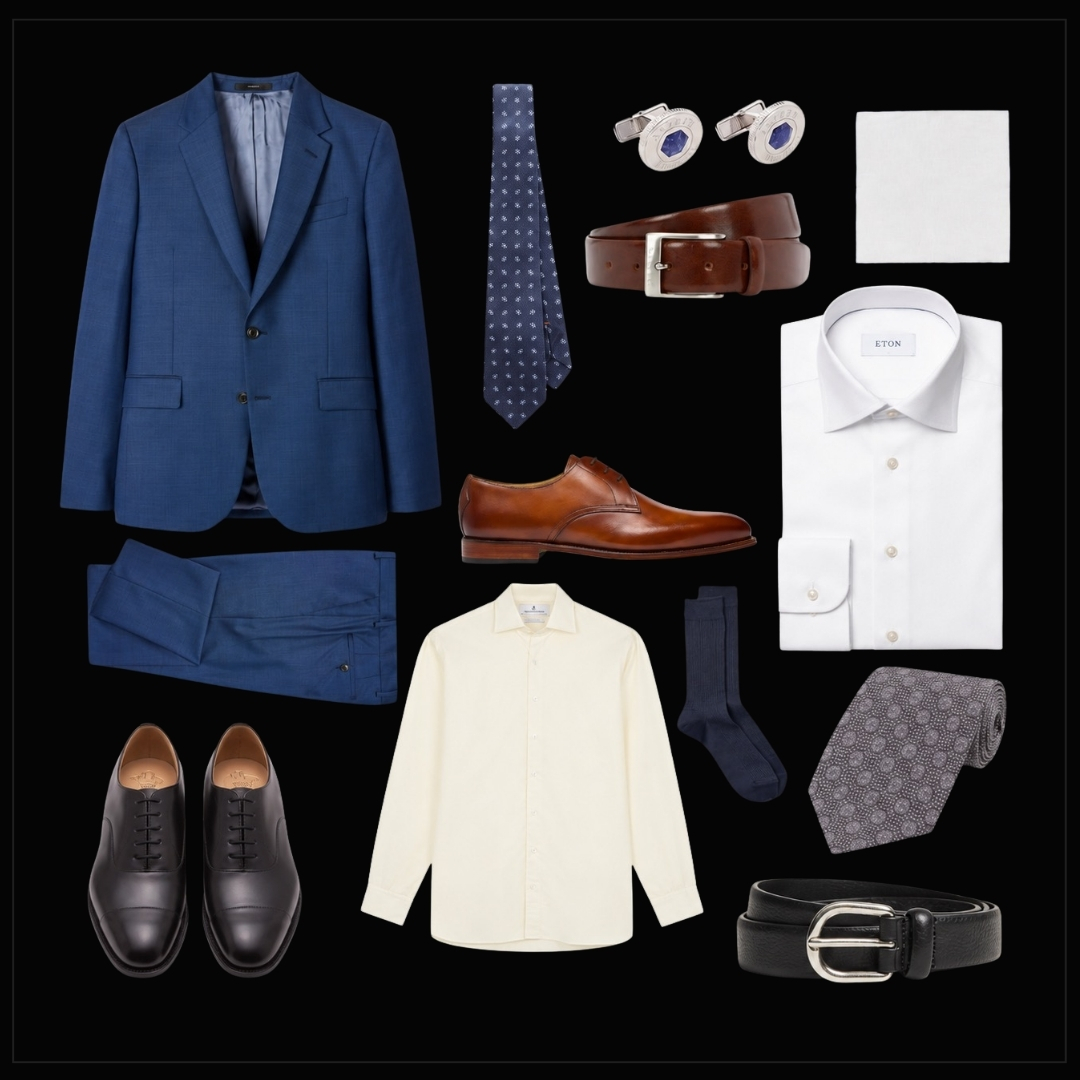
Wedding Reception
See the outfit →
Cocktail Party
See the outfit →
Garden Party
See the outfit →
Rooftop Party
See the outfit →
Dinner Party
See the outfit →
Movie Premiere
See the outfit →
What not to wear for cocktail attire?
Cocktail Attire is flexible, but that flexibility still has boundaries.
Things to avoid include:
- Wearing a dinner suit when the invitation simply says Cocktail Attire;
- Treating Cocktail as Smart Casual and arriving in an overly everyday outfit;
- Wearing a business suit without adapting it at all for a social occasion;
- Choosing very casual footwear for a traditional Cocktail setting;
- Assuming that removing the tie automatically makes the outfit more modern;
- Pairing a jacket and trousers that almost match and look like a poorly reconstructed suit;
- Wearing too many statement pieces at once;
- Choosing a shirt or knit that is too casual for the context;
- Ignoring the venue, season or time of day;
- Assuming Cocktail always means suit and tie regardless of context.
Cocktail Attire is flexible, but the outfit should always look intentionally put together for an occasion.
Cocktail Attire becomes much easier once you stop looking for one universal outfit and start thinking in terms of levels of formality. Begin with the invitation, then use the type of event, venue, time of day, season and your role to decide where to sit within the Cocktail spectrum. A suit will often remain the safest starting point, but separates, ties, fabrics, colours and footwear can then be adjusted according to the context. The right Cocktail outfit should feel clearly dressed for the occasion without becoming either everyday clothing or Black Tie eveningwear.
About Drover Club
Drover Club is a men’s online styling service that helps men dress right for the moments that matter. For weddings, business events, black-tie evenings, cocktail parties and other special occasions, we curate complete, ready-to-shop outfits from different brands, based on your style preferences, budget, sizes and existing wardrobe.