Black Tie Attire for Men: What to wear and How to Get It Right?
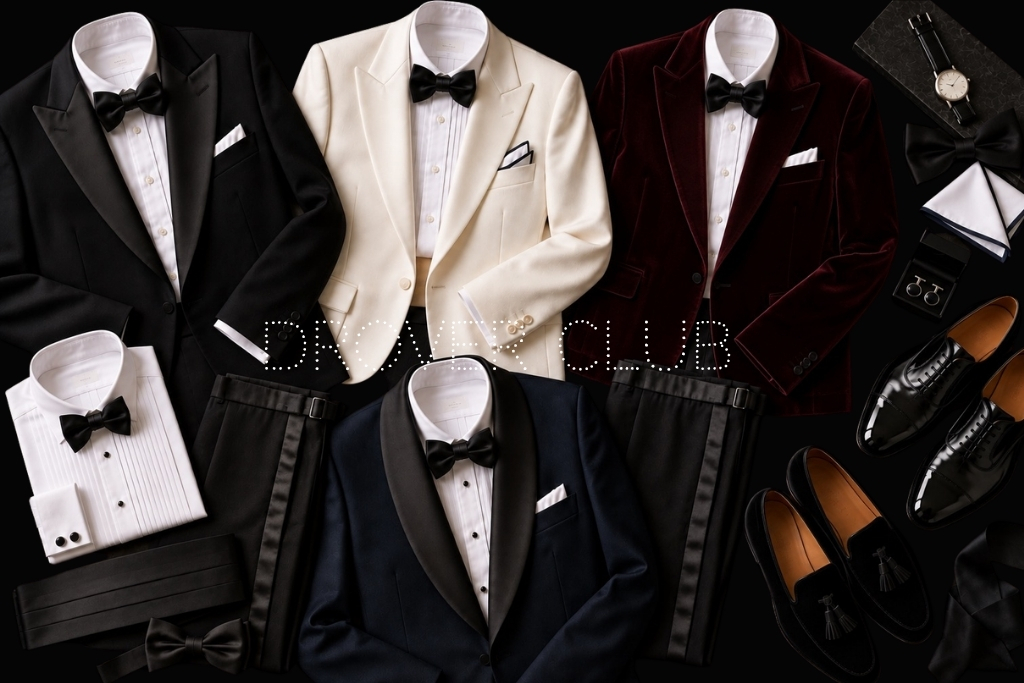
Black tie is a formal evening dress code built around the dinner suit: a dinner jacket, matching evening trousers, a white evening shirt, a black bow tie and formal black footwear. Unlike more flexible dress codes such as cocktail or smart casual, it follows a relatively defined set of conventions.
That does not mean every black-tie outfit has to look the same. Once the foundations are right, there are still choices to make: black or midnight blue, peak lapels or a shawl collar, different shirt details, the treatment of the waist, the finish of the shoes and a small number of restrained accessories.
The key is understanding what actually defines black tie, where you have genuine room for choice and how those choices should work for the event and your personal style. This guide breaks down each part of the outfit, explains the difference between Black Tie and Black Tie Optional, and helps you work out what to do if you do not already own everything you need.
This guide is for you if…
01 - "I have a black-tie event coming up and I’m not completely sure what I’m expected to wear."
02 - "I understand the basics, but I’m not sure which parts of black tie are actually non-negotiable."
03 - "I don’t own everything I need for black tie and I want to know what I can reuse, rent or buy."
04 - "I want the outfit to feel like me without getting the dress code wrong."
Black tie attire at glance
Get the foundations right first. Personalisation comes afterwards.
Table of Contents
- What Does the Black Tie Dress Code Actually Mean?
- The Black Tie Outfit, Piece by Piece
- What Is Non-Negotiable and Where Can You Personalise?
- Black Tie vs Black Tie Optional
- What If You Don’t Own a Dinner Suit?
- Black Tie Attire for Different Events
- What Not to Wear to a Black-Tie Event
- FAQ - Black Tie Attire for Men
What does the black tie dress code actually mean?
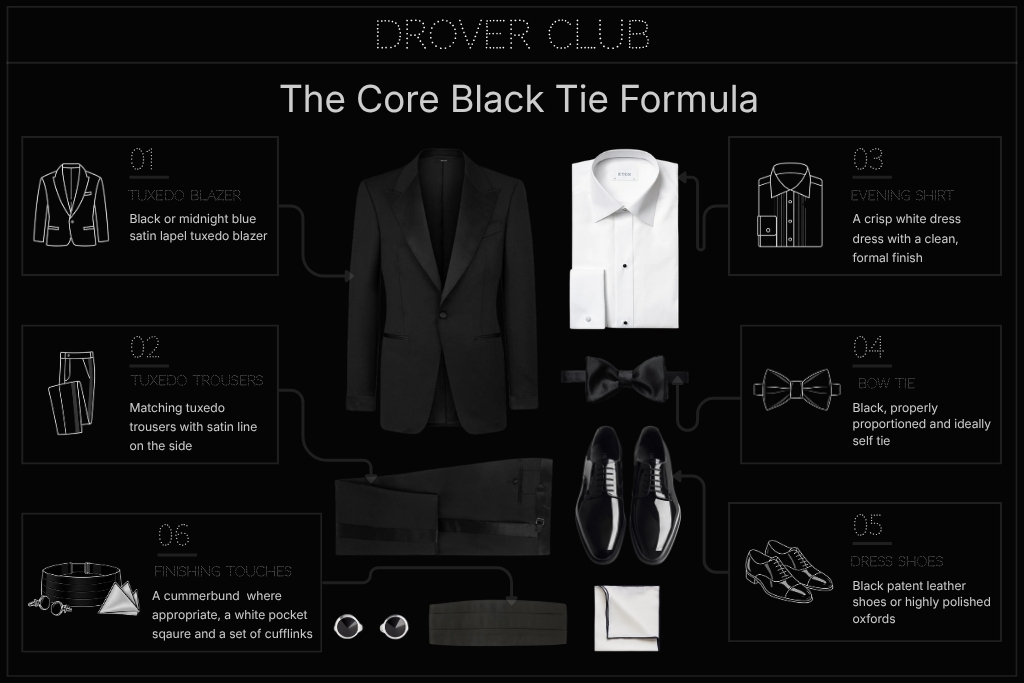
Black tie is a formal evening dress code centred on the dinner suit, known as a tuxedo in American English. When an invitation says Black Tie, it is not simply asking you to dress “very smartly”. It refers to a specific set of eveningwear conventions. The foundation consists of a black or midnight-blue dinner jacket with the appropriate evening trousers, a white shirt, a black bow tie and formal black shoes. Within that structure, certain details can vary without taking the outfit outside the dress code.
That distinction matters. A dark suit can be elegant and highly formal, but it is not the same as a dinner suit when an invitation explicitly calls for Black Tie. A dinner jacket has details specific to eveningwear, as do the trousers designed to accompany it. For the traditional British conventions, Debrett’s guide to black tie provides a detailed reference for the dress code and its core components. Black tie therefore allows less freedom than cocktail or smart casual, but rules should not be confused with uniformity. You can respect the dress code while still making choices around fit, proportions, lapels, certain fabrics and accessories.
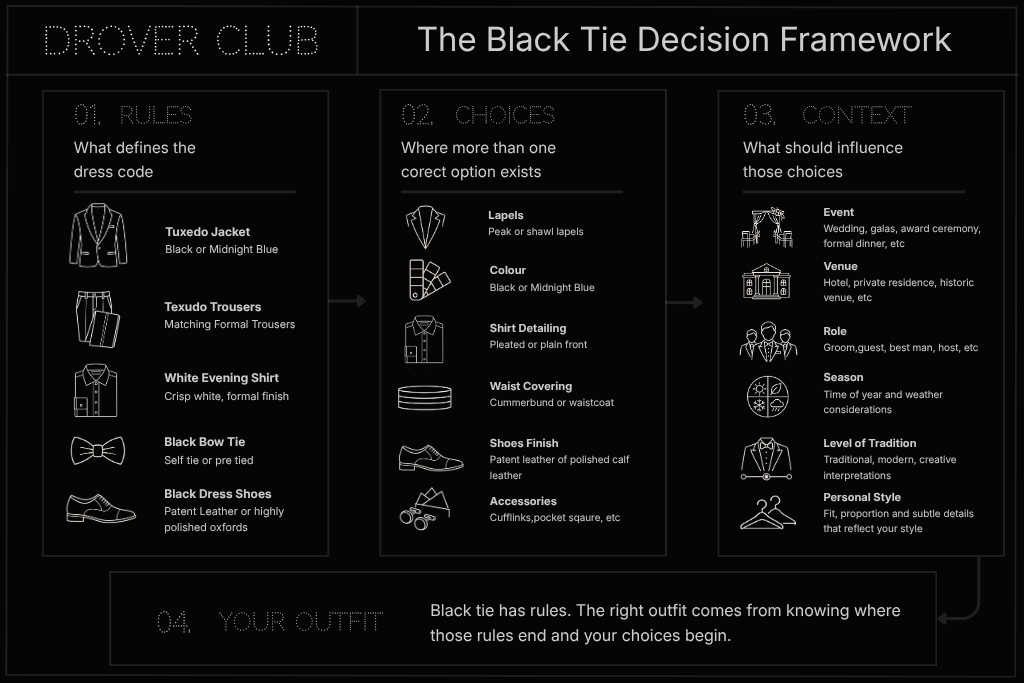
That is the logic behind the rest of this guide: Rules → Choices → Context → Your Outfit. The rules establish what makes an outfit genuinely black tie. The choices allow for different correct interpretations. The context then helps determine which of those choices best suits the event and the person wearing them.
The black tie outfit, piece by piece
Every part of a black-tie outfit has a purpose. The aim is not simply to follow a list of rules, but to understand what separates proper eveningwear from an ordinary formal suit.
The dinner jacket
The dinner jacket is the piece that most immediately identifies a black-tie outfit. It is traditionally black or midnight blue and differs from an ordinary suit jacket in several ways, most visibly through lapels faced in satin, grosgrain or another fabric that creates a subtle contrast with the body of the jacket.
The two most classic options are peak lapels and a shawl collar. Peak lapels create a more structured silhouette, while a shawl collar gives the jacket a softer, continuous line. A double-breasted dinner jacket can also sit comfortably within the black-tie tradition. Midnight blue should be understood as a genuine classic option rather than a modern alternative designed to avoid wearing black. Under certain artificial lighting, it can even appear deeper than black itself.
The crucial distinction is between a black suit jacket and a dinner jacket. Colour alone is not enough: the lapels, pockets, buttons and overall construction all contribute to its eveningwear character.
Good to know: A black jacket is not automatically a dinner jacket.
The evening trousers
The trousers should feel like a natural continuation of the jacket rather than a separate piece chosen afterwards. They are normally cut from the same cloth as the jacket and traditionally feature a satin or grosgrain braid along the outer seam, corresponding with the facing of the lapels. The waistband is deliberately clean.
Classic dinner-suit trousers are generally not designed to be worn with a belt; side adjusters or braces allow the waist to remain visually uncluttered. Fit remains essential. Trousers that are too long, too tight or poorly proportioned can undermine an outfit even when every other element is technically correct.
Good to know: A dinner suit works as a complete ensemble: ordinary black suit trousers are not automatically interchangeable with evening trousers.
The white evening shirt
The shirt provides the contrast that gives the outfit its structure. White is the standard for black tie. Depending on the style, an evening shirt may have a plain, pleated or marcella front. Double cuffs and cufflinks are also common, while some evening shirts are designed to take studs in place of visible buttons. One question comes up frequently: do you have to buy a shirt specifically designed to be worn with a dinner suit?
A proper evening shirt remains the most coherent choice for a traditional interpretation. In some contemporary settings, a very clean and sufficiently formal white dress shirt can also work. What matters most is avoiding details that pull the shirt noticeably towards businesswear or casualwear: visible patterns, colour, overly informal construction or sporty details.
Good to know: The shirt should support the outfit rather than become its focal point.
The black bow tie
The black bow tie is one of the defining elements of the dress code. For traditional black tie, a standard black necktie is not an equivalent substitute for a black bow tie. Its fabric can ideally correspond with the lapel facing satin with satin or grosgrain with grosgrain, for example creating a subtle connection between the different parts of the outfit.
A self-tie bow tie is traditionally preferred for its slightly imperfect, more natural shape, but proportion matters more than the tying method alone. The bow should work with the wearer’s face, shirt collar and lapel width. The bow tie is generally not where to introduce a major stylistic departure.
Good to know: In good black tie, personality is more often expressed through fit and detail than through a statement bow tie.
Evening waistcoat, cummerbund or neither?
This is one of the areas of black tie that creates the most uncertainty. With a single-breasted dinner jacket, a cummerbund or low-cut evening waistcoat can cover the area between the shirt and trousers and maintain a cleaner line when the jacket is open. With a double-breasted jacket, the question is different because the jacket itself naturally covers this area when worn fastened.
Contemporary black tie also frequently sees single-breasted jackets worn without a waist covering. The decision therefore depends partly on how traditional the interpretation is intended to be, the construction of the dinner suit and the nature of the occasion. The better question is not simply: “Do I absolutely need a cummerbund?” but: “What treatment of the waist works with my dinner suit and the level of formality of the event?”
Black tie shoes
Your shoes need to maintain the same degree of formality as the rest of the outfit. Black patent-leather shoes belong to the traditional black-tie vocabulary. Under many contemporary interpretations, understated black Oxfords in smooth leather, polished to a high shine, can also work. Opera pumps also form part of traditional evening dress, although they are considerably less common today.
Certain evening slippers can be appropriate in specific contexts, but they are not necessarily the most universal option. Brown shoes, trainers and styles with particularly heavy or casual soles, by contrast, tend to sit too far away from the level of formality required. This does not necessarily mean buying patent-leather shoes for a single occasion. If you already own a sufficiently formal pair of understated black Oxfords, the sensible first step is to establish whether they work with the rest of the outfit.
Good to know: Before buying something new, check whether what you already own genuinely meets the dress code.
Black tie accessories
Accessories should complete the dinner suit rather than compete with it. A white pocket square is a simple, classic option. Cufflinks and shirt studs can also complete an evening shirt when it is designed to take them. Braces can be used to keep the trousers sitting correctly without introducing a belt.
A watch requires more nuance. Traditional conventions were restrictive about wearing one with formal evening dress. Today, a slim and discreet watch is commonplace, whereas a large sports or technical watch can easily jar with the rest of the outfit. The same principle applies to jewellery. A small number of carefully chosen pieces can bring character; an accumulation of accessories quickly becomes unnecessary.
Good to know: The more formal the dress code, the less personal style needs to be demonstrative.
What is non-negotiable and where can you personalise?
Not every decision carries the same weight in a black-tie outfit. Certain elements immediately establish the dress code. Others are precisely where two men can make different decisions while both remaining correctly dressed.
Fit is also one of the best ways to make black tie personal. Lapel width, jacket proportions, the line of the trousers and the overall silhouette can have a major effect on the finished outfit without changing the dress code. The same applies to fabric and texture. A midnight-blue dinner suit, a shawl collar or a more pronounced grosgrain can give two technically correct outfits very different characters.
By contrast, replacing a defining part of the outfit with something from a different register trainers, a colourful necktie or an ordinary suit jacket goes beyond simply personalising black tie. Personalisation should happen within the dress code, rather than by replacing the elements that define it.
Black tie vs black tie optional: understanding the differences
The two expressions sound similar, but they create an important difference for the guest. Black Tie means that the dinner suit is the expected form of men’s evening dress. Black Tie Optional maintains a high level of formality but also allows a sufficiently formal dark suit. The simplest way to understand the distinction is: With Black Tie Optional, the dinner suit is optional, the formality is not.
If you choose a dinner suit for a Black Tie Optional event, it should still be worn as a dinner suit. The word optional is not permission to combine eveningwear with considerably more casual pieces. If you choose a suit, the overall effect should still be distinctly formal: a well-cut dark suit, white shirt, appropriate tie and formal black shoes provide a reliable foundation. Black Tie Optional does not mean “wear whatever you want”. It simply allows you to maintain the required formality without making a dinner suit compulsory.
What if you don't own a dinner suit?
Receiving a black-tie invitation does not necessarily mean immediately buying an entirely new outfit. Start by checking exactly what the invitation asks for, then look at what you already own.
If the invitation says black tie
A conventional dark suit is not the same as a dinner suit. Adding a black bow tie does not change its construction or the details that distinguish eveningwear from ordinary tailoring. If you do not own a dinner suit, there are two main options: rent or buy. Renting can make perfect sense for a one-off event or an occasion you are unlikely to encounter regularly.
Buying becomes more worthwhile if several formal events are likely to arise over the coming years or if you want something tailored more precisely to your own proportions. That does not mean every component needs to be new. If you already own an appropriate shirt, sufficiently formal black Oxfords or suitable accessories, those pieces may be reusable. The aim is not to start from zero. It is to identify what already works and what is genuinely missing.
If the invitation says black tie optional
You have another option: a formal dark suit. If you already own one that fits properly, there may be no need to rent or buy a dinner suit purely for that occasion. The rest of the outfit should nevertheless remain clearly formal. Optional does not move the dress code down to cocktail or smart casual.
Should you rent or buy?
Cost is not the only consideration. A correctly chosen dinner suit that fits badly is still a badly dressed dinner suit. Fit, proportion and overall coherence matter more than accumulating accessories.
What do you already own?

Black tie attire for different events
Black tie remains black tie regardless of the event. However, the context can influence how you use the limited choices available within the dress code. The venue, your role and how traditional the occasion is can all help determine whether your interpretation should remain very classic or whether some details can be more expressive.
Good to know: Context changes the interpretation of black tie, not its foundations.
Black tie wedding
At a black-tie wedding, the dress code chosen by the couple remains your first point of reference. For a guest, a classic interpretation is generally a particularly safe foundation: a well-fitting dinner suit, restrained accessories and no attempt to become the visual focus of the occasion. Your role matters too. The groom, best man or members of the wedding party may receive additional instructions that do not apply to ordinary guests.
If you are attending a wedding but the invitation does not specifically call for black tie, see our complete guide to Wedding attire for men.
See one complete outfit for a Black Tie Wedding → What to wear to a Black Tie wedding?
Charity gala
A charity gala can range from a highly traditional dinner in a grand hotel to an evening organised by a cultural or creative institution. When the dress code is black tie, the foundations remain the same. What can vary is primarily how much expression the details allow. When the context is unfamiliar, a classic interpretation remains the most dependable choice.
See one complete outfit for a Charity Gala → What to wear to a Charity Gala?
Movie premiere
A film premiere may allow more room for personal expression, but it is important to distinguish red-carpet dressing from guest dressing. Actors, artists and public figures attending professionally may use the red carpet as a space for stylistic expression. That does not automatically make the same choices appropriate for every guest. If your invitation says Black Tie, begin with the correct foundations. The creative setting can then influence the silhouette, certain textures or a small number of details.
See one complete outfit for a Movie Premiere → What to wear to a Movie Premiere?
Casino night
A casino night is not automatically a black-tie event. The theme may evoke James Bond or a particularly glamorous evening, but the dress code provided by the organiser should always take precedence. If the invitation says Black Tie, a dinner suit is appropriate. If it says Cocktail or Smart Casual, a dinner suit may instead be unnecessarily formal. The theme of an event does not replace its dress code.
See one complete outfit for a Casino Night → What to wear to a Casino Night?
Cannes film festival
The Cannes Film Festival encompasses screenings, premieres, dinners, receptions and private events whose dress requirements are not all identical. The useful question is therefore not: “What do you wear to Cannes?” but: “Which specific event am I attending, and what does that invitation require?” Where Black Tie is specified, the principles in this guide apply. Other moments during the festival may call for a different level of formality.
See one complete outfit for the Cannes Film Festival → What to wear to Cannes Film Festival?
Black tie event
When an invitation simply says Black Tie, with no unusual context, a classic interpretation remains the best place to start. Get the defining elements right first, check the fit and coherence of the complete outfit, then use the choices available within the dress code to make it your own.
See one complete outfit for a Black Tie Event → What to wear to a Black Tie event?
Explore Black-Tie Outfits by Setting

Black Tie Wedding
See the outfit →
Charity Gala
See the outfit →
Movie Premiere
See the outfit →
Casino Night
See the outfit →
Cannes Film Festival
See the outfit →
Black Tie Event
See the outfit →
What not to wear to a black tie event?
Most black-tie mistakes come from the same misunderstanding: replacing an element of evening dress with something that is simply smart or formal.
Things to avoid include:
- Wearing a business suit and presenting it as a dinner suit;
- Replacing the black bow tie with a conventional necktie when strict Black Tie is requested;
- Wearing brown or clearly casual shoes;
- Adding trainers simply to make the outfit feel “more modern”;
- Wearing a belt with evening trousers designed to be worn without one;
- Choosing a shirt with overly casual or business-oriented details;
- Overloading the outfit with accessories or statement pieces;
- Interpreting Black Tie Optional as permission to dress casually;
- Ignoring fit simply because all the technically correct pieces are present.
These conventions are not intended to make every outfit look identical. They simply preserve the characteristics that make black tie immediately recognisable.
Black tie becomes much easier once you separate the rules that define the dress code from the choices available within it. Start with the correct foundations. Then use fit, proportions, fabrics, subtle details and the context of the event to build an outfit that feels appropriate to you. The aim is not to reinvent black tie. It is to wear it correctly without losing your own sense of style.
About Drover Club
Drover Club is a men’s online styling service that helps men dress right for the moments that matter. For weddings, business events, black-tie evenings, cocktail parties and other special occasions, we curate complete, ready-to-shop outfits from different brands, based on your style preferences, budget, sizes and existing wardrobe.